
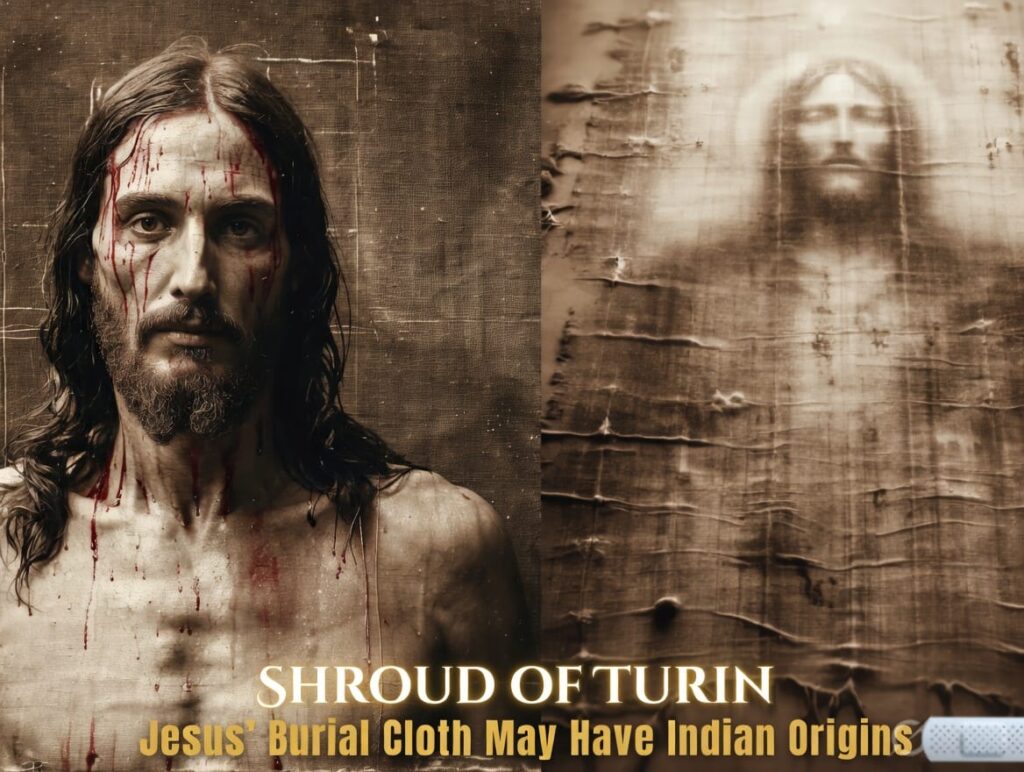
The Shroud of Turin, a centuries-old linen cloth bearing the faint image of a man who appears to have suffered physical trauma consistent with crucifixion, has long been one of the most studied and controversial artifacts in human history. Recently, sensationalist headlines on social media platforms like Instagram and Facebook have claimed that “New DNA analysis suggests the Shroud of Turin may have Indian origins.”
While these headlines grab attention, the truth is far more nuanced. This article explores the origins of this claim, the scientific reality behind the DNA tests, and the historical and spiritual significance of the Shroud.
The Origin of the News: Where Did This Come From?
The “Indian connection” isn’t a brand-new discovery from 2026; it stems from a major study published in 2015 in the journal Scientific Reports (part of the Nature publishing group). The research was led by Dr. Gianni Barcaccia and a team of geneticists from the University of Padua in Italy.
The study aimed to sequence the mitochondrial DNA (mtDNA) of dust and pollen particles recovered from the Shroud to understand its “biogeographic history”—essentially, a map of everywhere the cloth has been and who has touched it over the centuries.
Is the News True? The DNA Evidence Explained
The claim that the Shroud is “Indian” is a classic example of scientific findings being taken out of context. Here is what the University of Padua study actually found:
- A Global DNA Map: The researchers found DNA traces from people all over the world, including Western Europe, the Near East, North Africa, and South and East Asia (India and China).
- The Indian Link: Some of the DNA found on the cloth belongs to haplogroups (genetic lineages) typically found in India.
- Contamination, Not Origin: The presence of Indian DNA does not mean the cloth was made in India or that the man wrapped in it was Indian. Because the Shroud has been displayed publicly for centuries, it has been handled or breathed upon by thousands of pilgrims, priests, and travelers from across the globe.
Why the Shroud Likely Isn’t “Indian” (The Scientific Hurdles)
There are several historical and scientific reasons why labeling the Shroud as “Indian” is inaccurate:
- Manufacturing Style: The weaving technique of the Shroud is a “three-to-one herringbone twill,” which was common in the Near East and the Mediterranean during antiquity, rather than the traditional weaving styles found in ancient India.
- Pollen Evidence: Previous studies found pollen grains on the cloth that are specific to the region around Jerusalem and Turkey, suggesting its primary residence was in the Middle East before moving to Europe.
- The Carbon Dating Controversy: In 1988, laboratories at the University of Oxford, the University of Arizona, and ETH Zurich performed radiocarbon dating. They concluded with 95% confidence that the linen dates back to 1260–1390 AD. While some critics argue the samples used were from later repairs, this remains the primary scientific argument against its 1st-century origin.
A Brief History of the Shroud
To understand why people are so invested in its origin, one must look at its journey:
- The Disappearance: If authentic, the Shroud would have originated in Jerusalem (approx. 33 AD).
- The Middle Ages: The first documented historical record of the Shroud we see today appeared in Lirey, France, in the 1350s.
- The House of Savoy: In 1453, it was acquired by the royal House of Savoy and eventually moved to Turin, Italy, in 1578, where it has remained ever since in the Cathedral of Saint John the Baptist.
The Intersection of Science and “Aastha” (Faith)
For millions of Christians worldwide, the Shroud is much more than a piece of ancient linen; it is a Holy Relic. The word “Aastha” (Faith) is central to the Shroud’s existence.
- The Silent Witness: Believers see the Shroud as a “silent witness” to the resurrection of Jesus Christ. The wounds visible on the image—bloodstains on the wrists, feet, side, and forehead—match the biblical descriptions of the Passion of Christ perfectly.
- The Miracle of the Image: Scientists have never been able to fully explain how the image was formed. It is not painted, dyed, or burned. It is a “negative” image that only becomes clear when photographed. To those with Aastha, this is a divine sign that science simply cannot decode.
- The Church’s Stance: The Catholic Church neither formally confirms nor denies its authenticity, referring to it instead as an “icon” that inspires meditation on the suffering of Christ.
Conclusion: Fact vs. Fiction
The “Indian Origin” headline is a scientific half-truth. While Indian DNA is present on the cloth, it likely got there through centuries of global trade and the touch of devoted pilgrims from the East.
The Shroud of Turin remains a bridge between the physical and the spiritual. Whether it is a clever medieval artwork or the actual burial cloth of Jesus Christ, its power lies in its ability to challenge our understanding of history and ignite the flame of faith in the hearts of the devout.